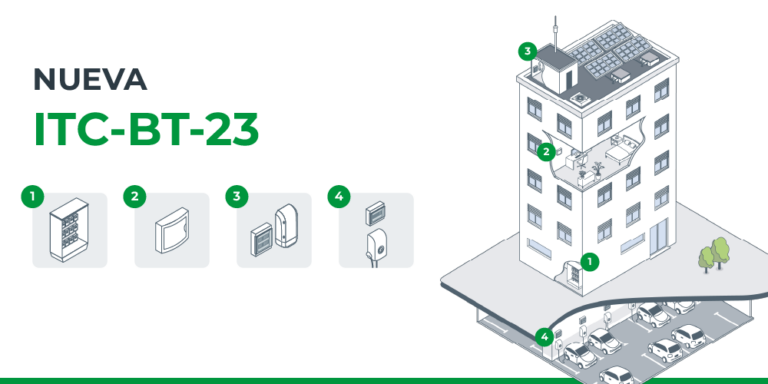
New edition of the REBT ITC-BT-23 Guide on surge protection: protection staging, coordination and other control measures.
Last November, a new version of the Guide to Complementary Technical Instruction ITC-BT-23, “Indoor or receiving installations. Surge Protection”, of the Low Voltage Electrotechnical Regulation (REBT), was published.
Main updates to ITC-BT-23 on surge protection
The main reason for this update was to clarify when and how to provide adequate surge protection in installations equipped with lightning protection systems, since the previous edition did not specify this, which had caused some confusion and left this type of installation unprotected.
The new edition clearly states the obligation to protect installations with lightning protection systems using transient surge protection devices. Specifically, it states that these must be Type 1, in line with the provisions of SUA 8, “Safety against the risk caused by lightning”, of the Technical Building Code.
“In building installations that have external lightning protection systems, such as lightning rods, Franklin rods, Faraday cages, etc., according to the provisions of the CTE, SUA 8, and Annex B.2, the conductors of electrical circuits subject to mains supply voltage and the conductors of telecommunications circuits must be protected by transient surge protection devices installed at the origin of the building installation; these must be Type 1.”
Likewise, the new edition introduces other measures for effective surge control:
- It invokes the mandatory installation of surge protection in electric vehicle charging installations according to ITC-BT-52.
“Furthermore, the new ITC-BT-52 includes the need for surge protection in installations for electric vehicle charging.” - It recommends the use of Type 3 transient surge protection devices for sensitive and high-value equipment such as computer equipment, plasma or LED screens, PLCs, electronic equipment in industrial machinery, etc.
“In addition, it is advisable to take into account the cost and sensitivity of the equipment, since the more sensitive and expensive a device is, the greater the protection it should receive. This is the case for computer equipment in general, plasma or LED screens, latest-generation household appliances, PLCs, electronic equipment in industrial machinery, etc. In these cases, the arrangement of protections shall be carried out in accordance with Chapter A of this Guide, using Type 3 transient surge protection devices.” - Especially exposed installations, such as outdoor installations including outdoor lighting and photovoltaic systems, require transient surge protection according to Guide BT-40.
“For especially exposed installations such as outdoor installations, for example outdoor lighting and photovoltaic systems, the integration of a greater number of electronic devices and components requires the use of transient surge protection devices. In these cases, the arrangement of protections shall be carried out in accordance with Chapter A of this Guide, using Type 2 transient surge protection devices. Specific recommendations for surge protection in photovoltaic installations are provided in Guide BT-40.”
Installation and best practices in protection coordination
Many installations require more than one protection stage. This provides greater discharge capacity while ensuring a reduced residual voltage.
The new edition also reinforces the concept of cascade protection and coordination between protection devices, setting a recommended distance of 10 metres between devices to ensure such coordination.
“In the event that several transient surge protection devices need to be installed in cascade, for example one general or main device and others on specific outgoing circuits, the usage information provided by the manufacturer should be consulted to achieve proper coordination. In long installations, and where secondary distribution boards are available or can be installed, it is advisable to install additional Type 2 transient surge protection devices approximately every 10 m, as established in UNE-CLC TS 61643-12.”
This ensures that the first protection stage is activated first and diverts most of the energy. The second stage will then reduce the residual voltage.
In distribution boards where the two protection stages are centralised and there is no 10 m separation, combined protection devices must be used, or decoupling coils must be installed to simulate the cable distance.
On the other hand, independently of the minimum distance between devices required to ensure coordination, the distance between protection devices and the equipment to be protected must not exceed 10 meters. Otherwise, oscillations and electromagnetic fields may occur, increasing the residual voltage and damaging sensitive equipment. To guarantee this minimum distance, it may be necessary to install several cascade protection levels, while respecting the coordination principles mentioned above.